Untangling from Big Tech: Alternatives to Amazon
How (and why) I've avoided shopping at the big river store for years
The Resistance Garden is a free publication focused on all the small ways we, as individual citizens, can resist the rise of authoritarianism and build a more just society together. If you’ve found anything I’ve written helpful and want to show your support, I appreciate every like, share, and subscription. You can also buy me a coffee below, or browse zines and other products in my online shop. Thanks for reading!
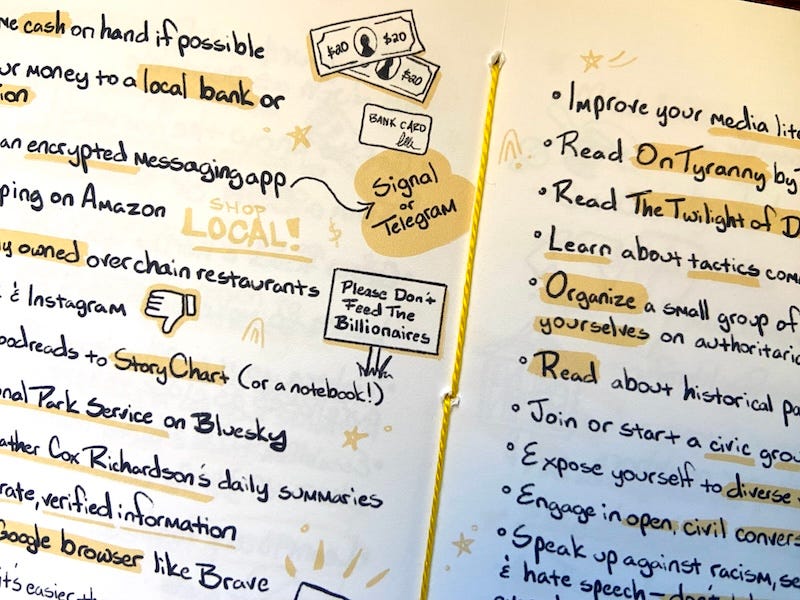
This is Part 2 of my Untangling from Big Tech series, which itself is part of my attempt to flesh out some of the tips from my Resist zine.
Part 1 was focused on identifying the problem and finding your reason for doing this work of untangling from big tech.

This post will focus specifically on finding alternatives to Amazon. Future posts will cover other services like Google and Meta, as well as bringing analog alternatives back into our lives, and getting off the cloud.
To be clear, I’m not anti-technology. I am, however, anti-big-invasive-all-consuming-platforms-run-by-billionaires-who-want-to-leave-us-here-to-perish-while-they-fly-off-to-another-f’ing-planet.
What do I know about ditching Amazon?
A few years ago, I made the internal commitment to stop buying from Amazon, and I’m proud to say I haven’t bought anything from them in 2-3 years. I’m not positive on the timeframe because I’ve since deleted my account, but I can confidently say it’s been at least 2 years.
I also don’t use Prime or Audible. To be super honest, I’m not even sure what their streaming platform is called now, and I don’t care enough to look it up.
Presumably, if you’re reading this series, you already want to move away from Amazon. But just to say it, I’m not telling you this to virtue signal or sound judgmental if you still shop there. Please know that. Only to let you know that I’ve put in the work finding alternatives in my own life for several years now. Also, to show you that it’s entirely possible to exist in 2025 without free 2-day shipping.
Is avoiding shopping on Amazon a sign of privilege?
I have to acknowledge the privilege issue up front. There is a level of privilege in play anytime you’re able to decide where and how to spend your money. Just having options is a privilege easily taken for granted.
And I acknowledge that I’m fortunate to live in an area with access to decent grocery stores, a good library, and a few locally owned businesses. Not to mention the internet access to search for non-Amazon options online.
That said, I’ve seen some pushback recently saying how shopping at Amazon is now a necessity for those on very low incomes, and as a freelance designer with a Very Low household income, I want to gently push back on that pushback.
Yes, Amazon does offer low prices on lots of things people need. That’s hard to deny.
But I would first argue that many of the things people buy from Amazon don’t fall into that “need” category. And, even if they do, there are other options, which we’ll talk about next.
Does the convenience and few dollars saved make up for the environmental damage of creating an entire economy based on churning out cheap shit and getting it to you as fast as robotically possible without regard for the health and safety of the humans in the supply chain? Does it make up for running small businesses out of the market, or making them sell through the Amazon platform for less? Does it create a future where we have quality goods and services available in our own communities, or one built around warehouses and fleets of big electric Amazon vans that quack when they back up?
Has no one seen the Lorax?? Because this is literally the plot.
I’m not a politician, a tech bro, or a big-name podcaster. I don’t have political power or a lot of money to help shape our collective future. What I do have is my voice and my choices. I can choose what to speak up about and what to support with my hard-earned dollars each week.
I can choose to spend that money as much as possible locally, feeding the economy where I live, and in turn, bettering my own future and hopefully that of my kids.
I can opt to buy from businesses that treat their people with respect, and to the extent that I’m able, I can avoid spending money with mega corporations that don’t care if my community thrives or even survives.
I can become okay with a little friction, a little less convenience in my day-to-day, in the name of a future I want to participate in creating.
Anyway, those are my personal feels. They may be different from yours, and that’s fine. Our goals are the same.
Whatever brought you here, from this point forward, we’re going to talk less about feels and more about how we can start to untangle ourselves from Bezos’ ecosystem and find/create our own replacement sources for the media, goods, and services we’ve been padding his pocket for.
I don’t have all the answers, but I can tell you what I’ve done, and there are a lot of great articles popping up every day along this same vein.
Before you start down this road, adjust your expectations
In my last post, I talked about having a good reason for why you want to untangle yourself from big tech, because it’s not always easy, and it’s rarely the most convenient option.
That’s beyond true in the case of Amazon.
Depending on how you use the platform, how many items you have on a recurring subscription, how many books you go through each month, how much of your household stock of paper goods, or k-cups, or whatever comes from there, you’re likely going to experience some friction as you make a change. Expect it, account for it, and do it anyway. It will pass, and in the end, you’ll have a more resilient and satisfying supply chain and media ecosystem.
Feeling strongly that what you’re doing is the right thing is how you maintain your resolve when you encounter friction.
Here are a few things that helped me successfully break up with Amazon:
Make it a non-negotiable. For me, at least, a huge part of not shopping on Amazon was committing to not shopping on Amazon. It took a few months of off and on experimenting before I completely quit, but once I made the promise to myself, I was able to stick with it.
If you can’t commit to not buying anything from them, start with one category at a time. For example, commit to not buying any books from them, or start switching your subscription items to another service one at a time.
Delete the app from your phone to make it easier to avoid mindless shopping as a coping mechanism. This was something I found myself doing for a few months in the beginning, opening the app randomly just to look for something to buy.
Make the alternative equally convenient. When you find a website or resource to replace something you would have gone to Amazon for, make it easy to remember it in the future. Bookmark it, set it up on a subscription, whatever makes it a no-brainer to get back to.
Remember that sometimes not shopping on Amazon will require determination. Its a behemoth for a reason… and that reason is shitty labor practices and blatant disregard for the environment.
Where to find alternatives:
Here are a few specific resources I’ve turned to, as well as some general advice for finding your own.
Just to let you know, a couple of the links below are referral links from my personal accounts (Grove and Libro specifically). If you choose to click on those and make a purchase, we both get some kind of small reward.
General Advice:
Start by going straight to the source. If you have a pretty good idea of what you’re looking for, start by searching for it as usual, but instead of clicking on the first search result to come up (often an Amazon link), scroll through and go straight to the manufacturer’s website to see if it’s available there. They may sell through their own website, or be able to point you to a local business carrying their products.
If the manufacturer uses Amazon for fulfillment, or doesn’t offer the item directly, look for smaller e-commerce sites or specialty shops.
Try using a non-Google browser to search and see if you come up with different, more varied results. In my experience, the results on Google lean heavily towards Amazon and large big-box stores. When I’ve tried to find the same things using the Brave browser’s built-in search, I feel like I find more niche e-commerce sites and small shops around the country.
Consider whether you actually need the thing in the first place. Retailers spend mass quantities of money to convince us we need more things. Before you spend your precious time and money adding a new thing to your life, stop and really consider whether you need the thing at all.
Books, Movies, and TV Shows:
Buy audiobooks through libro.fm and choose which local, independent bookstore your money supports. You can also buy packs of credits or subscribe monthly.
For paper books, borrow from your library or buy at a local bookstore.
Shop online at bookshop.org to support independent book sellers.
Find less expensive used options at Thriftbooks or Half Price Books.
To track books you’ve read and your endless TBR pile, switch from Goodreads (an Amazon-owned company) to The StoryGraph.
Or, go old school and write it down. Grab a notebook and make it your book journal; you can take notes and track your reading in one spot. The other day I saw where someone printed out tiny book covers for every book they read and glued it in their book journal. Get creative if you want!
I don’t have a lot of recommendations for shows, because that’s not an aspect of Amazon I used much. I will say again, though, check your local library. Our library has lots of TV series and movies available, both on DVD and through Hoopla, including some I know you’d find on Prime.
Gifts:
Most farmers’ markets have a few art or craft vendors mixed in as well. Consider shopping for small handmade gifts from local vendors throughout the year for the holidays, and skip the deluge of Amazon boxes in December.
Etsy can also be a good option for unique toys or gifts.
Consider gifting an experience, a fun class, or a membership to a local museum or activity.
Kids Stuff:
I cannot stress enough how many quality second-hand kids’ clothes are out there in circulation, especially for little kids. They grow so fast that you can often find brand-new-looking items, especially for the 5-and-under crowd. Between thrift stores, consignment shops, and hand-me-downs from family and friends, we rarely buy new clothes for the kids. The exception being an occasional cute outfit or holiday pajamas.
The same applies to toys—the second-hand options are abundant. If you’re looking for new toys, consider local toy stores or boutiques, or if they’re unavailable / too expensive, look online for smaller e-commerce options.
Watch for large pop-up consignment sales. In our area, Duck Duck Goose and another large consignment sale happen nearby once or twice a year.
Household Goods and Groceries:
For food or cleaning supplies, shop local first, if you’re able.
If you are fortunate enough to live somewhere with access to farmers’ markets, take advantage of them.
You can obviously find produce and meat at farmers markets, but they may be a good source of other household items as well, from bar soap and salsa to pottery or linens.
Don’t underestimate the power of simple cleaning supplies. I keep a spray bottle with a mix of orange vinegar (white vinegar that has sat in a jar with orange peels for several weeks) and water on my counter with a microfiber rag. This is our all-purpose cleaner, and we just refill it as needed. No subscriptions or plastic bottles needed.
Buy organic food and household supplies at Thrive Market. You can set them up on autoship or order as needed.
For personal care and cleaning supplies you can’t find locally, try Grove Collaborative. They offer subscriptions on items, or you can shop as needed.
Azure Standard is another option for organic food and cooking staples. They are sort of a national grocery co-op that delivers monthly to community drop points around the country. I’ve found they have the best prices on organic oats and a few other things I like to stock up on.
For replacement and repair parts, search the internet for the part number or description. If you can’t find the part directly from the manufacturer (or it’s crazy expensive), look for sites that specialize in repair parts. There are a handful of sites I’ve used for replacement parts for appliances and household items. I even found a site specializing in vintage camper parts when I was fixing up an Airstream years ago. There are also smaller family-owned hardware stores around the country, and some of those also list parts online and are happy to ship them.
Clothes:
Skip fast fashion. Aim for quality over quantity. After years of cycling through ill fitting and poorly made shirts from the clearance rack of Old Navy, I’ve finally concluded that (for me) my time and money are better spent finding gently used high quality items made out of natural materials that will last a long time, instead of spending roughly the same amount on cheap crap that won’t last through three wears.
For inexpensive used items, try ThredUp or Poshmark, or hit up local thrift stores and yard sales.
If you’re looking for new clothes, go directly to the company’s website or search for an outlet option. Some higher-end clothing companies have outlets for refurbished or last season’s clothes.
In summary…
Know your why
Make the commitment
Delete the app
Pick one category to start with and search for alternatives
Make the alternative just as convenient, if possible
Repeat
This isn’t an exhaustive list of resources, partly because there are too many to name, and partly because it’s going to be different for everyone.
If you follow the steps above, though, you can start to take back your choices and curate your own supply chain that supports businesses and people you feel good about supporting.
I have been passing these little booklets out all over town!
I cancelled my Prime membership yesterday. No regrets.